
local_floristNEW! Announcing our Community Impact Report 2025: See our community's growth!
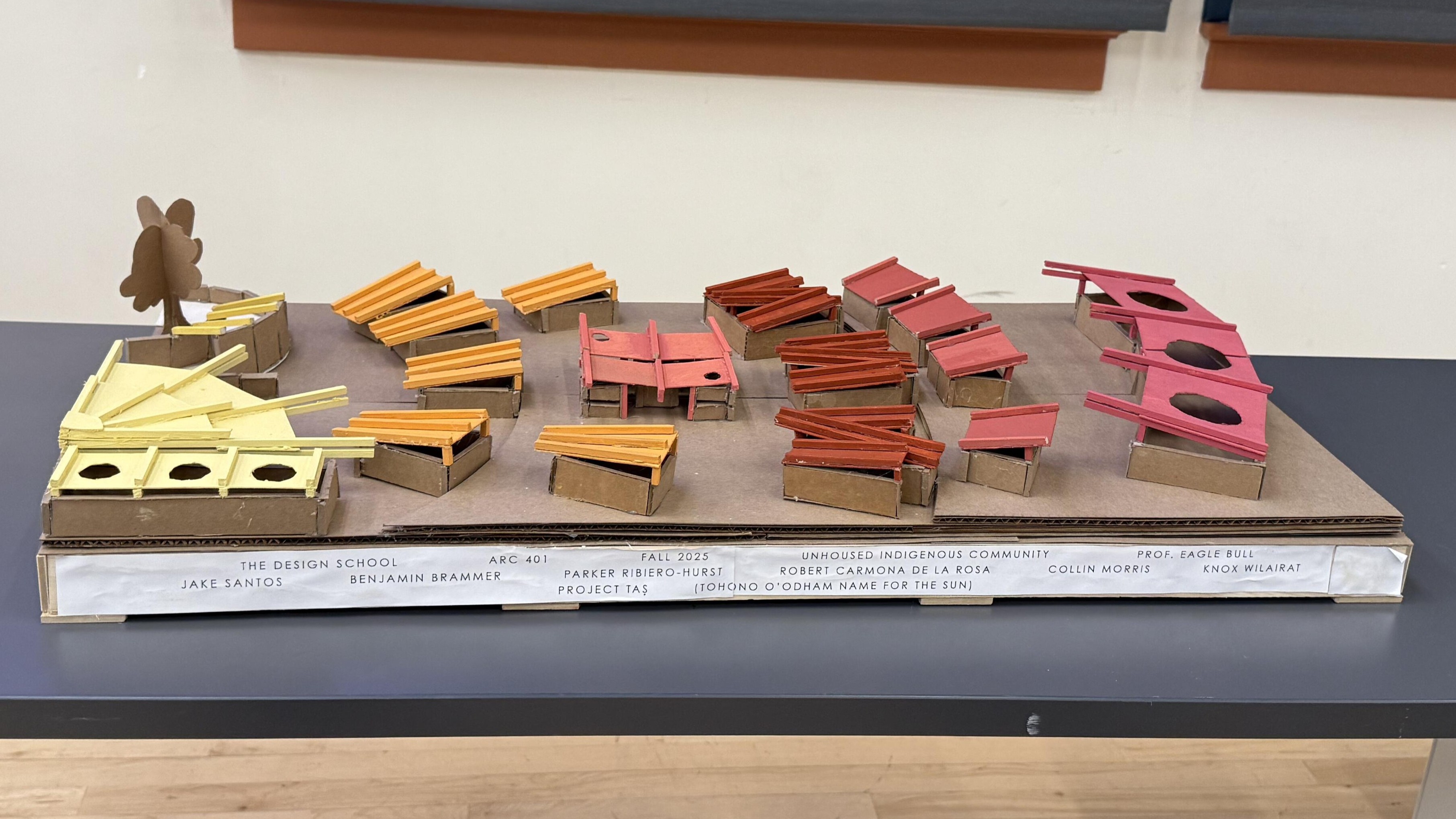
Check out our partnership with ASU architecture students to design culturally grounded, rapid-deploy shelter models that rethink dignity, safety, and service delivery for people experiencing homelessness.
NAC’s senior leadership team was grateful for the opportunity to engage with ARC 401 Studio (Indigenous Focus) students working with Professor Tammy Eagle Bull, Indigenous Design Collaborative at The Design School. NAC's team provided feedback on a shelter model project over the last couple of months, and the students were invited to tour several NAC properties to see how design and architectural choices impact services in real settings.

Their project focused on creating a rapid-deploy, non-congregate shelter model that could serve 60 individuals at a time on one of four proposed sites in the Phoenix area. The design considered single adults, families, and elders. Students used existing site conditions to plan modular units and essential service spaces such as admin offices, dining, laundry, conference rooms, storage, and parking.
The goal of the project was to explore how design can support dignity, safety, empowerment, and effective service delivery for people experiencing homelessness, while still being realistic, functional, culturally appropriate, and easily deployable. The proposed sites were centered around Native culture and practices, which the students reflected throughout their overall designs. Check out more photos of the project presentation below.
Thank you to the instructors and students at The Design School for engaging in this impactful project and sharing your innovative designs.


Our traditions are the foundation of our organization - explore, learn, and utilize resources available for all.

Get the support you need with health, housing, and community services available at Native American Connections.

Your support changes lives and builds healthy communities. Find ways to get involved.

A "chronically homeless" individual is defined to mean a homeless individual with a disability who lives either in a place not meant for human habitation, a safe haven, or in an emergency shelter or in an institutional care facility if the individual has been living in the facility for fewer than ninety (90) days and had been living in a place not meant for human habitation, a safe haven or in an emergency shelter immediately before entering the institutional care facility. In order to meet the ‘‘chronically homeless’’ definition, the individual also must have been living as described above continuously for at least twelve (12) months or on at least four (4) separate occasions in the last three (3) years, where the combined occasions total a length of time of at least twelve (12) months. Each period separating the occasions must include at least seven (7) nights of living in a situation other than a place not meant for human habitation, in an emergency shelter or in a safe haven.
Federal nondiscrimination laws define a person with a disability to include any (1) individual with a physical or mental impairment that substantially limits one or more major life activities; (2) individual with a record of such impairment; or (3) individual who is regarded as having such an impairment. In general, a physical or mental impairment includes, but is not limited to, examples of conditions such as orthopedic, visual, speech and hearing impairments, cerebral palsy, autism, epilepsy, muscular dystrophy, multiple sclerosis, cancer, heart disease, diabetes, Human Immunodeficiency Virus (HIV), developmental disabilities, mental illness, drug addiction, and alcoholism.