
local_floristNEW! Announcing our Community Impact Report 2025: See our community's growth!
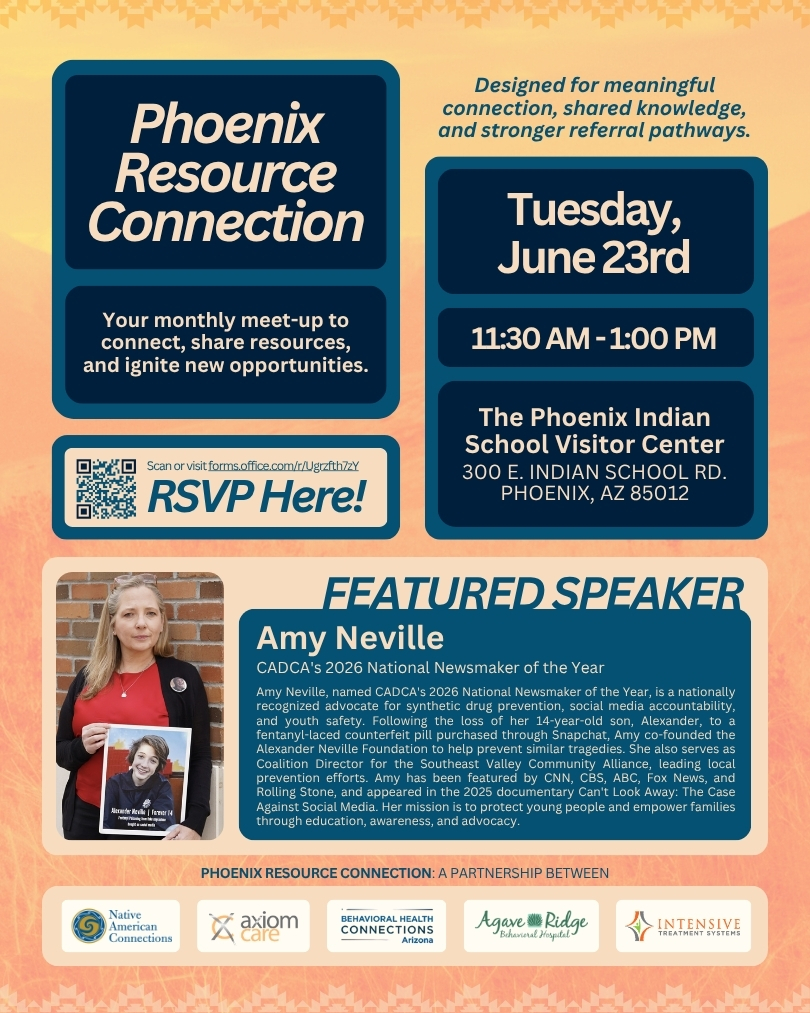
Designed for meaningful connection, shared knowledge, and stronger referral pathways, Phoenix Resource Connection is your space for behavioral health networking in Phoenix, AZ.
We're excited to welcome behavioral health professionals for our monthly Phoenix Resource Connection Networking Event on Tuesday, June 23rd! RSVP to attend: https://forms.office.com/r/Ugrzfth7zY
Join us as we bring together providers, community partners, and advocates to connect, share resources, and strengthen referral pathways across Arizona's behavioral health community.
PRC is honored to feature Amy Neville, CADCA's 2026 National Newsmaker of the Year, a nationally recognized advocate for synthetic drug prevention, youth safety, and social media accountability. Amy's powerful story and mission to protect young people through education, awareness, and advocacy continue to inspire communities across the country.
We look forward to seeing everyone!
Our traditions are the foundation of our organization - explore, learn, and utilize resources available for all.

Get the support you need with health, housing, and community services available at Native American Connections.

Your support changes lives and builds healthy communities. Find ways to get involved.

A "chronically homeless" individual is defined to mean a homeless individual with a disability who lives either in a place not meant for human habitation, a safe haven, or in an emergency shelter or in an institutional care facility if the individual has been living in the facility for fewer than ninety (90) days and had been living in a place not meant for human habitation, a safe haven or in an emergency shelter immediately before entering the institutional care facility. In order to meet the ‘‘chronically homeless’’ definition, the individual also must have been living as described above continuously for at least twelve (12) months or on at least four (4) separate occasions in the last three (3) years, where the combined occasions total a length of time of at least twelve (12) months. Each period separating the occasions must include at least seven (7) nights of living in a situation other than a place not meant for human habitation, in an emergency shelter or in a safe haven.
Federal nondiscrimination laws define a person with a disability to include any (1) individual with a physical or mental impairment that substantially limits one or more major life activities; (2) individual with a record of such impairment; or (3) individual who is regarded as having such an impairment. In general, a physical or mental impairment includes, but is not limited to, examples of conditions such as orthopedic, visual, speech and hearing impairments, cerebral palsy, autism, epilepsy, muscular dystrophy, multiple sclerosis, cancer, heart disease, diabetes, Human Immunodeficiency Virus (HIV), developmental disabilities, mental illness, drug addiction, and alcoholism.